

When Two Paths Meet: Using the Enneagram and IFS for Deep Transformation
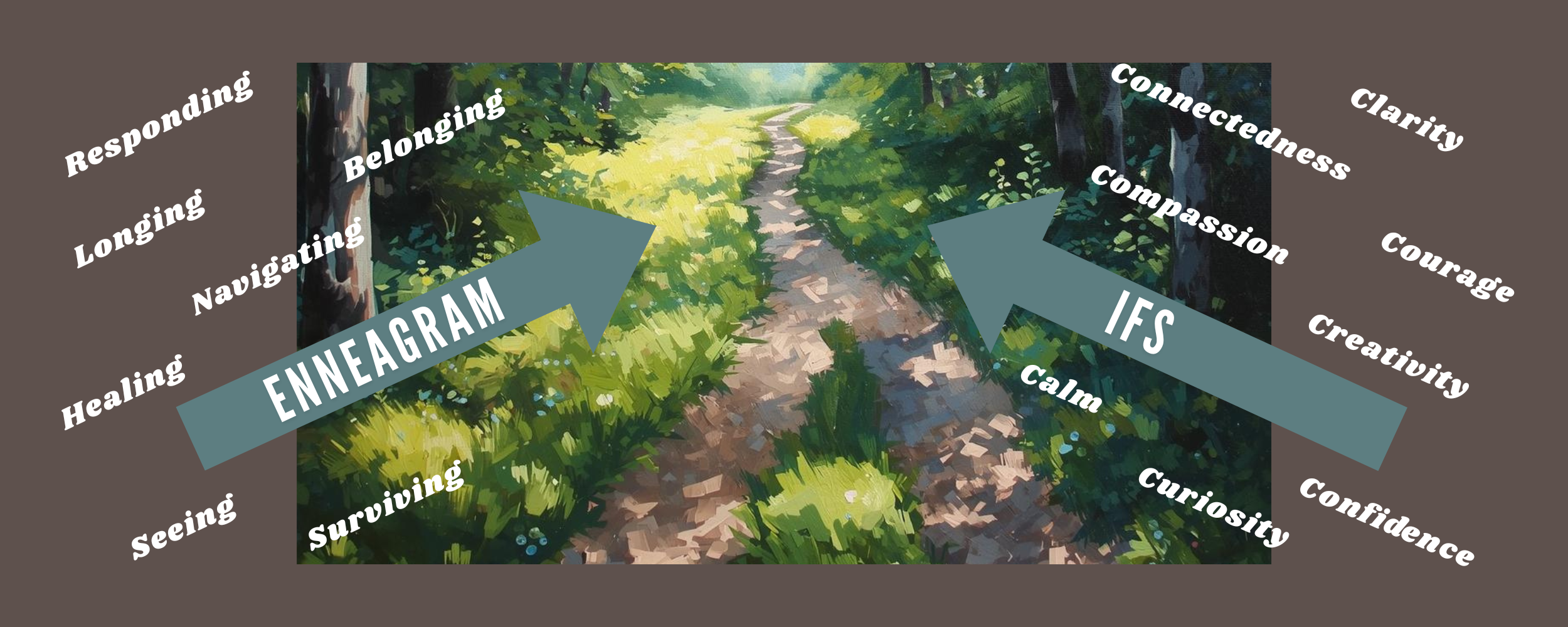
There are moments in the healing journey when two separate paths unexpectedly converge and offer a way forward that is richer and more grounded than either path alone. For many people, discovering complimentary nature of Internal Family Systems therapy and the Enneagram is one of those moments. Each system offers a unique lens through which we can view our inner world. Together they provide clarity, compassion, and a practical road map for real, embodied change.
If you have already been exploring the Enneagram or are beginning to learn about IFS, you may sense the overlap. You might also have questions. Are they compatible? Do they contradict each other? How can these two frameworks support Christian spiritual formation without replacing it?
We would like to offer an introduction to the ways the Enneagram and Internal Family Systems naturally complement one another. Both give language to the complexities inside us. Both honor the goodness of our design and the pain of our wounds. And both help us move toward wholeness in ways that align beautifully with a Christian view of personhood, grace, and redemption.
What is the Enneagram?
The Enneagram is a map of nine distinct patterns that help explain how different people perceive the world, navigate relationships, and respond to stress. While often misunderstood as a personality test, the Enneagram is better understood as a window into our early survival strategies.
Each of the nine types represents a core way of seeing, reacting, and protecting ourselves that was shaped in childhood. These patterns are intelligent and adaptive. They helped us make sense of a world that did not always feel safe, predictable, or attentive to our needs. Over time, these patterns became familiar and automatic.
The goal of the Enneagram is not to place people into boxes. It is to help us see the box we are already in and to offer pathways out of it. It reveals both our unconscious motivations and the higher, redeemed capacities within us.
What is Internal Family Systems (IFS)?
Internal Family Systems begins with a premise many people intuitively know: within every human being there are multiple parts. These parts carry different emotions, desires, beliefs, and coping strategies.
IFS helps us understand that our anger is a part. Our fear is a part. Our drive to achieve is a part. Our retreat into isolation is a part. Each part longs to protect us in the best way it knows how, even when its strategies create pain or conflict.
At the core of IFS is the belief that underneath all our parts we have something called the Self. This is the God-given center of our being characterized by calmness, clarity, courage, and compassion. The more Self-led we become, the more our parts can relax and stop carrying burdens they were never meant to hold.
Like the Enneagram, IFS understands that our inner world is shaped by both the beauty and brokenness of our stories. And like the Enneagram, it moves us toward freedom through curiosity, kindness, and personal responsibility.
How the Enneagram and IFS Fit Together
Once you understand the basic framework of each system, their compatibility becomes unmistakable. The Enneagram explains why we do what we do. IFS explains who inside us is doing it. Together they allow us to see the shape of our personality and the parts within it that drive our behaviors.
Let us explore the most significant areas of overlap and how this combination can create powerful transformation.
The Enneagram Reveals Patterns
IFS Reveals the Parts Within Those Patterns
Each Enneagram type reflects a survival strategy. Type One learned to be good. Type Two learned to be helpful. Type Three learned to be successful. Type Four learned to be unique. And so on.
IFS would say that within each type live multiple parts working hard to maintain that strategy.
For example:
A Type Six may have a vigilant part that watches for danger, a doubting part that second-guesses decisions, and a loyal part that clings tightly to trusted relationships.
A Type Two may have a pleasing part that scans for the needs of others and a fearful part that worries about losing connection.
A Type Eight may have a protective part that rises quickly with intensity and a younger vulnerable part it is guarding.
The Enneagram identifies the pattern.
IFS identifies the team inside that pattern.
Both perspectives are needed to understand the full picture.
The Enneagram Names Our Core Fear
IFS Helps Us Meet the Fear with Compassion Instead of Shame
We all have core fears, from both nature and nurture. With IFS, we do not shame these fears or try to eliminate them by force. We sit with them, listen to them, and help them unburden what they have been carrying for far too long. This process allows the Enneagram’s insights to move from intellectual awareness to real transformation.
For example:
A Type Three’s fear of worthlessness is held by a part that was once a child who learned that love might be withdrawn when they slowed down.
A Type Four’s fear of being defective belongs to a part that longed to be fully seen and felt invisible.
A Type Nine’s fear of conflict is rooted in a part that once experienced harmony as fragile and connection as conditional.
Each Enneagram type carries a core fear that shapes much of its worldview.
IFS helps us approach that fear with gentleness rather than judgment.
The Enneagram Explains Our Automatic Reactions
IFS Helps Us Slow Them Down
Each Enneagram type has a natural reaction under stress. Those reactions are the parts attempting to protect us. Becoming aware of, and noticing, yours in real time, creates space to make proactive choices. It increases self leadership. And it opens the door for the Spirit of God to minister to us in places that were previously closed off.
IFS helps us pause, notice, and relate to those parts instead of letting them take over.
For example, instead of:
A Type Eight erupting,
A Type Two instantly rescuing, or
A Type Five withdrawing without warning,
IFS gives language to say, “A part of me is activated. I can turn toward it with compassion instead of letting it drive the whole system.”
The Enneagram helps to identify a person’s typical instinctive, self-protective reaction under stress
IFS helps us approach stressed parts with gentleness rather than judgment.
The Enneagram Highlights Our Blind Spots
IFS Creates Safe Internal Dialogue to Explore Them
Every Enneagram type has habitual ways of defending against pain.
Type Seven distracts.
Type Four amplifies emotion.
Type One tightens control.
Type Five retreats inward.
Type Three performs.
IFS provides a gentle way to speak to the parts that engage in these defenses. Instead of judging them, we ask,
“What is this part protecting me from?”
“What does it fear would happen if it did not do its job?”
“What does it need from me?”
When we approach our blind spots with curiosity rather than shame, they begin to soften.
Once again, the Enneagram shows us the pattern.
IFS helps us relate to the pattern in a healing way.
Why Christians Can Comfortably Use Both Systems
Both the Enneagram and IFS align with key Christian beliefs about human nature. They assume that people are created with dignity, formed by experience, and capable of growth.
The Enneagram resonates with the biblical theme that humans are shaped by both God’s image and the effects of the Fall. It acknowledges the ways we adapt to survive in a world that does not always reflect the love of God.
IFS reflects the Christian belief that beneath our wounded parts is a core that bears the character of God’s presence. IFS calls it the Self. Scripture describes it as the new creation or the Spirit bearing witness to who we truly are. Both point to the idea that the truest part of us is not our pain or our fear but the divine imprint God placed within us.
Neither system replaces the Gospel. Neither system saves us. They simply give us language for our humanity, our wounds, and the places where God is already at work.
How the Enneagram and IFS Together Support Spiritual Formation
For many people, spiritual formation has been shaped by willpower, self criticism, and attempts to suppress undesirable behaviors. Both IFS and the Enneagram offer a different way. They teach us to approach ourselves the way Jesus approaches people with gentleness, honesty, and compassion.
They help us name what is happening inside
Instead of trying to fix symptoms, we learn to discern the deeper motivations underneath our reactions.
They allow space for the Spirit to minister to our inner world
When we unburden parts of us from fear, shame, or self protection, we become more receptive to God’s presence.
They support relational healing
Understanding our patterns and parts helps us communicate more clearly, create safety, and repair ruptures more quickly.
They nurture humility
Both systems remind us that we are shaped by forces larger than ourselves and that we need grace for our blind spots.
They encourage growth that is practical, not theoretical
Transformation becomes something we practice in daily life: slowing down, noticing parts, grounding in the Self, and choosing new patterns.
Take a Step Toward Change
For those who long to grow but feel stuck, the integration of IFS and the Enneagram offers hope. It provides a clear, compassionate path forward that honors both the past and the present, the heart and the mind, and psychological insight and spiritual depth.
People who feel misunderstood begin to feel seen.
People who feel defective begin to understand the wisdom of their parts.
People who feel overwhelmed begin to find internal clarity.
People who feel spiritually frustrated begin to experience a more honest connection with God.
The combination of these two frameworks gives individuals a way to make sense of their stories without shame. It shows how our patterns developed, how our parts work to protect us, and how God meets us inside all of it.
This is the kind of work that changes lives in deep, lasting ways.